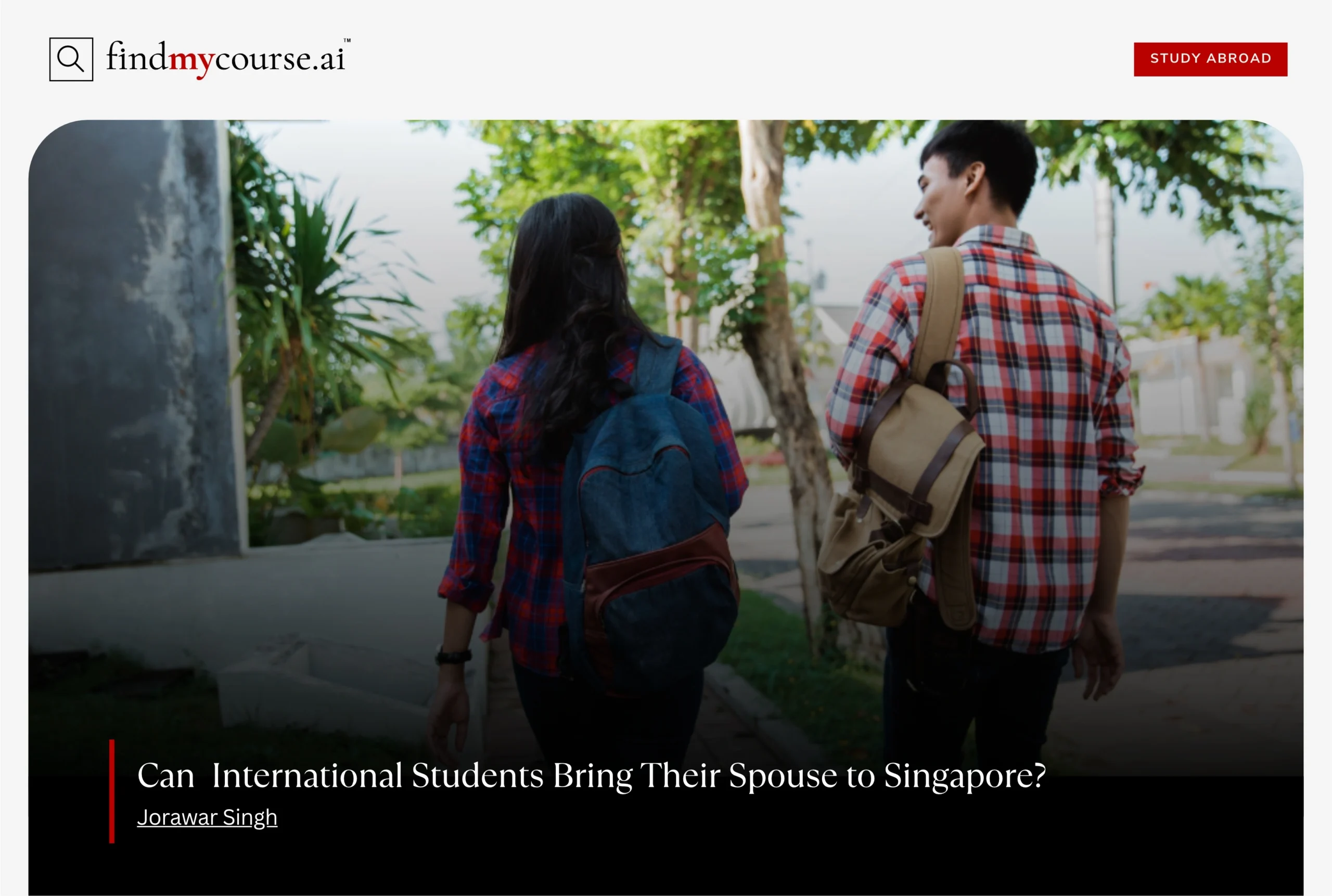
If you are planning to study abroad in Singapore, you may be wondering whether your spouse can live with you during your studies. Many students search for a “Singapore Spouse Visa,” but this term can be confusing because no such pass officially exists. Instead, Singapore offers different types of passes depending on your student status. Let’s make everything simple and explain your real options for 2026.
What Is the Singapore Spouse Visa?
The term “Singapore Spouse Visa” is commonly used online, but it is not an official immigration category. Singapore allows foreign spouses to stay through specific passes, primarily the Long-Term Visit Pass (LTVP) or the Dependant’s Pass (DP).
f you want to study in Singapore, it’s important to know that the appropriate pass depends on the sponsor’s immigration status, such as being a student, work pass holder, or resident. Because each pass comes with different rights and restrictions, it is important to understand which category applies to your situation before planning your spouse’s stay.
Can International Students Bring Their Spouse?
For Most Students
If you are coming to Singapore for a Bachelor’s degree or a regular Master’s degree (coursework), you cannot sponsor your spouse for a long-term visa. Your spouse can only come to visit for a short period, using a Short-Term Visit Pass (SVP).
- The Short-Term Visit Pass is like a tourist visa.
- Most visitors are given up to 30 days of stay on arrival (varies by nationality).
- Extensions are possible but not guaranteed and ICA approves them on a case-by-case basis. Extensions are not automatically up to 90 days.
- After the visit, your spouse must leave Singapore. They can try to return, but immigration may not always approve re-entry.
This means there is no long-term Singapore Spouse Visa for most students.
For Research Students (PhD, MPhil, etc.)
Some universities (not all) allow full-time graduate research students to apply for an Long-Term Visit Pass (LTVP) for their spouse. A support/sponsorship letter from the university is required, and approval is still subject to ICA.
- The Long-Term Visit Pass lets your spouse stay in Singapore for a longer period. If approved, ICA determines the LTVP validity period. Universities do not control the duration.
- To get this pass, your university must sponsor the application.
- You will need documents such as your marriage certificate, your Student Pass, and sometimes a letter from your university.
- Not every research student will get this option—each university has its own rules, and the process can take several weeks.
Can Your Spouse Work in Singapore?
This is a very important question for many couples! Here’s how it works:
1. If Your Spouse is on a Short-Term Visit Pass (SVP)
- No, your spouse cannot work in Singapore if they are in the country on a Short-Term Visit Pass.
- This pass is strictly for visiting, not for working or studying.
2. If Your Spouse is on a Long-Term Visit Pass (LTVP)
- Your spouse also cannot automatically work with just an LTVP.
- If your spouse wants to work while staying in Singapore on an LTVP, they must first find an employer willing to hire them or a Letter of Consent (LOC) if they are eligible under ICA’s LTVP category.
- The employer must then apply for a valid work pass for your spouse (like an Employment Pass, S Pass, or Work Permit).
- Your spouse can only start working after this work pass is approved by Singapore’s Ministry of Manpower (MOM).
Simply put: The LTVP alone does not give your spouse permission to work. Extra steps and approvals are needed.
3. If Your Spouse is on a Dependant’s Pass (After You Get an Employment Pass)
- When you start working in Singapore and bring your spouse on a Dependant’s Pass, your spouse can work, but only if they also get a valid Letter of Consent (LOC) or a proper work pass through an employer.
- The process is usually easier with a Dependant’s Pass, but work is not automatically allowed.
After You Graduate: A Different Path
Once you finish your studies and get a job in Singapore, you may be able to apply for an Employment Pass (EP). If your monthly salary is high enough (currently at least S$6,000), you can then apply for a Dependant’s Pass for your spouse.
- The Dependant’s Pass is the closest thing to a true “Singapore Spouse Visa.”
- This pass allows your spouse to live in Singapore with you while you work.
- To work, your spouse still needs a Letter of Consent or a separate work pass.
Summary Table
| Your Situation | Can Spouse Stay Long-Term? | Can Spouse Work? | What Pass Can They Get? |
| Bachelor’s/Master’s (coursework) | No | No | Short-Term Visit Pass |
| PhD/Research Student | Maybe (if university sponsors and ICA approval required) | Only with a separate work pass | Long-Term Visit Pass (LTVP) |
| Working (Employment Pass holder) | Yes (if salary meets requirement) | Yes, with a Letter of Consent or work pass | Dependant’s Pass |
Note: ICA has the final authority to approve or reject visa/stay applications, regardless of university support.
What You Should Do
- Contact your university’s international student office. Ask them if your program allows for spouse sponsorship and what documents you need.
- Prepare early. Get your marriage certificate (translated to English if needed), passports, and any other documents ready.
- Think about your spouse’s plans. If your spouse wants to work or study in Singapore, they must apply for their own work or student pass.
Final Advice
For most students, bringing your spouse to Singapore for a long stay is only possible if you are a research student, and even then, only if your university supports your application. If you are not eligible, your spouse can still visit you for a short time with a Short-Term Visit Pass. Once you find a job after graduation, it’s much easier to bring your spouse using a Dependant’s Pass, and they may be able to work with the right approvals.
If you have any questions or need help, always ask your university first—they know the most up-to-date rules and can guide you through the process.