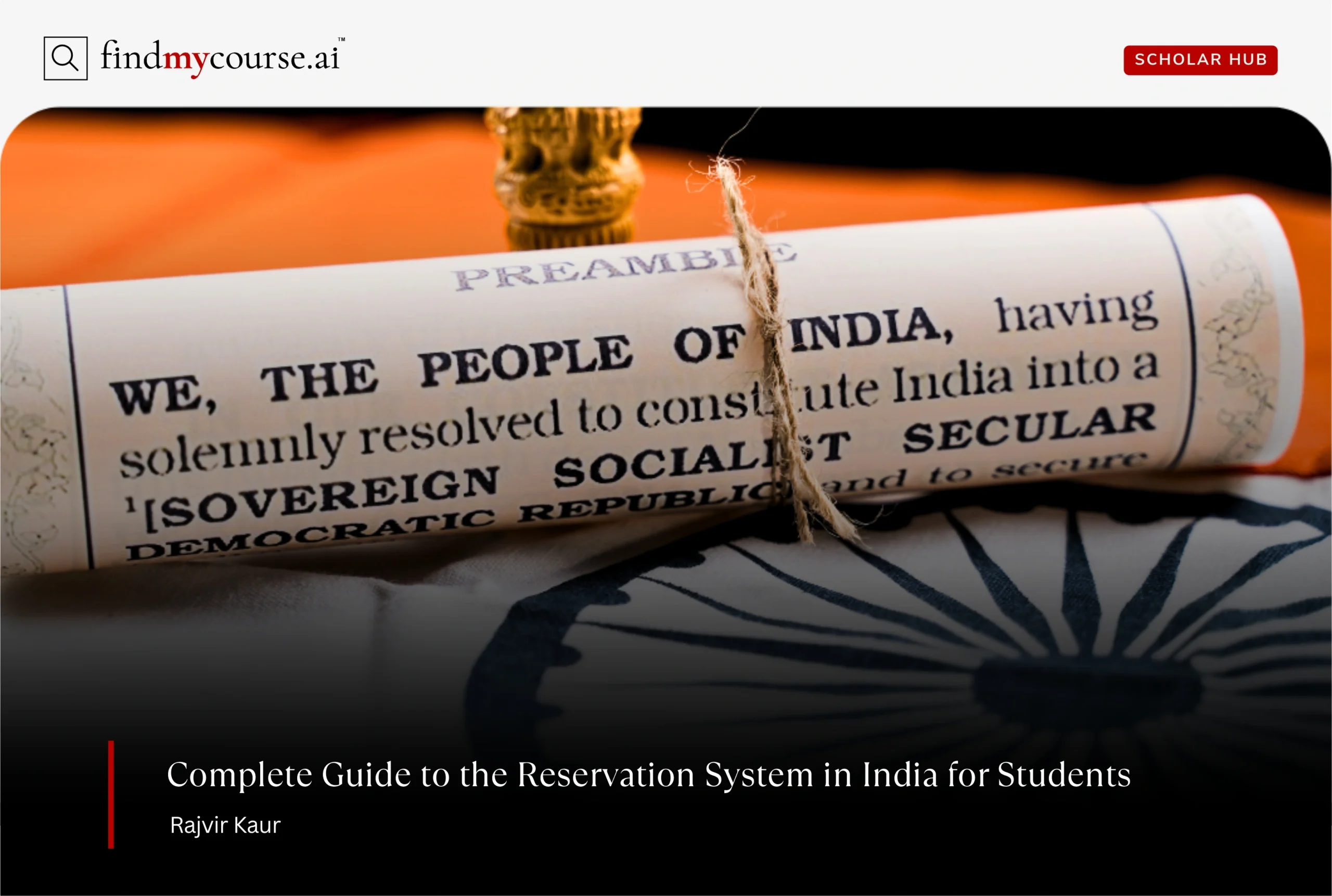
Few topics in Indian education spark as much debate as the Reservation System in India. For some, it represents long-overdue social correction. For others, it raises questions about fairness, merit, and opportunity. Yet, regardless of where one stands, reservation remains one of the most influential forces shaping access to higher education in the country.
Every year, millions of students compete for limited seats in universities, colleges, and institutes. In this crowded landscape, admission outcomes are not determined by scores alone. Social category, economic background, institutional type, and state policies all play a role. Therefore, understanding how reservation works is not just useful—it is essential for students and families navigating college education.
At a time when reforms like NEP 2020 are reshaping academic structures and pathways, reservation continues to operate as a core policy tool. This article breaks down how the system functions in practice, explains reservation categories in simple terms, and explores how cut-offs and seat allocation actually work.
What Is the Reservation System in India?
At its core, the Reservation System in India is a constitutional mechanism designed to expand access to education for groups that have been historically excluded. Rooted in Articles 15 and 16 of the Constitution, it allows the state to reserve seats in publicly funded institutions for socially and economically disadvantaged communities.
In higher education, reservation applies across undergraduate, postgraduate, and doctoral admissions in central universities, state universities, government colleges, and many aided institutions. Moreover, it also influences access to scholarships, hostels, and academic support systems.
However, reservation is often misunderstood as a dilution of merit. In reality, it does not replace merit-based selection. Instead, it restructures competition by creating category-specific merit lists. Students still need to meet minimum eligibility criteria, qualifying scores, and institutional standards set by bodies such as UGC and AICTE.
According to recent AISHE data, more than half of students enrolled in public institutions come from reserved categories. This highlights not only the scale of the policy but also its continued relevance in addressing educational inequality.
Reservation Categories Explained Simply
To understand how reservation works, it is important to first understand the categories it covers. Each category reflects a different form of historical or economic disadvantage.
Scheduled Castes (SC)
Scheduled Castes include communities that have historically faced social discrimination and restricted access to education and public resources. As a result, 15% of seats in central higher education institutions are reserved for SC candidates. This provision aims to address generational disadvantages by improving representation in universities and professional courses, while ensuring students still meet prescribed academic eligibility criteria.
Scheduled Tribes (ST)
Scheduled Tribes often live in geographically remote and economically underdeveloped regions, where access to quality schooling and academic support remains limited. Consequently, 7.5% of seats in central institutions are reserved for ST students. This reservation helps bridge structural gaps caused by isolation, language barriers, and lack of educational infrastructure, enabling greater participation in higher education over time.
Other Backward Classes (OBC – Non-Creamy Layer)
OBC reservation accounts for 27% of seats and applies only to candidates from the non-creamy layer, defined by an income and socio-economic threshold. This distinction ensures that reservation benefits reach families facing genuine educational disadvantage rather than economically advanced sections. Moreover, OBC reservation significantly expands access to competitive courses while maintaining category-wise merit-based selection.
Economically Weaker Section (EWS)
Introduced in 2019, EWS reservation provides 10% of seats to students from economically weaker backgrounds who are not covered under SC, ST, or OBC categories. It recognises that financial disadvantage alone can limit access to quality education. Therefore, EWS reservation focuses on income-based eligibility, offering support without altering existing social-category reservations.
Horizontal Reservations
Horizontal reservations operate across all social categories rather than within a single group. These include a 5% quota for Persons with Disabilities, along with state-specific provisions for women, defence personnel dependents, or freedom fighters’ families. As a result, eligible candidates compete within their category while also benefiting from additional protection, ensuring inclusivity without replacing vertical reservation norms.
Together, these categories aim to widen academic pathways without removing baseline academic requirements.
How Reservation Affects Cut-offs and Seats
One of the most visible effects of reservation is its impact on cut-offs. However, this is also where confusion is most common.
In most admission processes, institutions release separate cut-offs for each category. Therefore, a lower cut-off for a reserved category does not mean relaxed standards across the board. Instead, it reflects competition among candidates within that category.
Consider a college with 100 seats. These seats are divided according to reservation norms—15 for SC, around 7 or 8 for ST, 27 for OBC, and 10 for EWS. The remaining seats fall under the open category, which anyone can compete for, regardless of category.
Moreover, if reserved seats remain unfilled, institutions may convert them to other categories based on regulatory rules. This flexibility helps ensure that seats do not go vacant.
Importantly, reservation does not lower the quality of education. All admitted students must meet eligibility conditions such as qualifying exams, minimum scores, and entrance test requirements. Consequently, reservation changes access, not academic expectations.
Central vs State Reservation Differences in the Reservation System in India
The Reservation System in India does not operate uniformly across all institutions. A key distinction exists between central and state-level implementation.
Central Institutions
Central universities, IITs, AIIMS, and other centrally funded institutions follow uniform national reservation norms. These include fixed percentages for SC, ST, OBC, EWS, and horizontal reservations for PwD.
Because these rules apply nationwide, students from any state compete under the same framework. This consistency brings predictability, especially for national entrance exams.
State Institutions
State universities and colleges, however, follow reservation policies defined by state governments. As a result, total reservation may exceed 50% in some states. Additionally, states often introduce region-specific categories or sub-quotas.
Domicile requirements further complicate matters. Therefore, students applying across multiple states must carefully study local rules during counselling and seat allocation. Understanding these differences can significantly influence admission strategy and outcomes.
Common Myths and Misconceptions
Despite decades of implementation, misconceptions around reservation persist. One common belief is that reservation guarantees admission. In reality, competition within reserved categories can be intense, especially in high-demand courses.
Another myth is that reservation benefits only a narrow set of communities. However, today’s framework includes OBC, EWS, PwD, and other groups, reflecting a broader understanding of disadvantage. Some also assume that reservation undermines merit. Yet, since all students must meet eligibility standards, merit continues to matter—just within a more inclusive structure.
Therefore, informed understanding is far more useful than assumptions or oversimplified narratives.
Conclusion
The Reservation System in India remains a central pillar of higher education policy, even as the system itself undergoes transformation. Under NEP 2020, the focus has expanded to include flexibility, multidisciplinary learning, and employability. Reservation now operates within this broader reform landscape.
Going forward, policymakers must balance inclusion with quality and global competitiveness. For students and families, the key lies in understanding how reservation works—not as an abstract debate, but as a practical admission reality.
When implemented transparently and reviewed thoughtfully, the Reservation System in India continues to serve its original purpose: widening access while preserving academic standards.

2 thoughts on “Reservation System in India: How It Works in Higher Education”
Comments are closed.