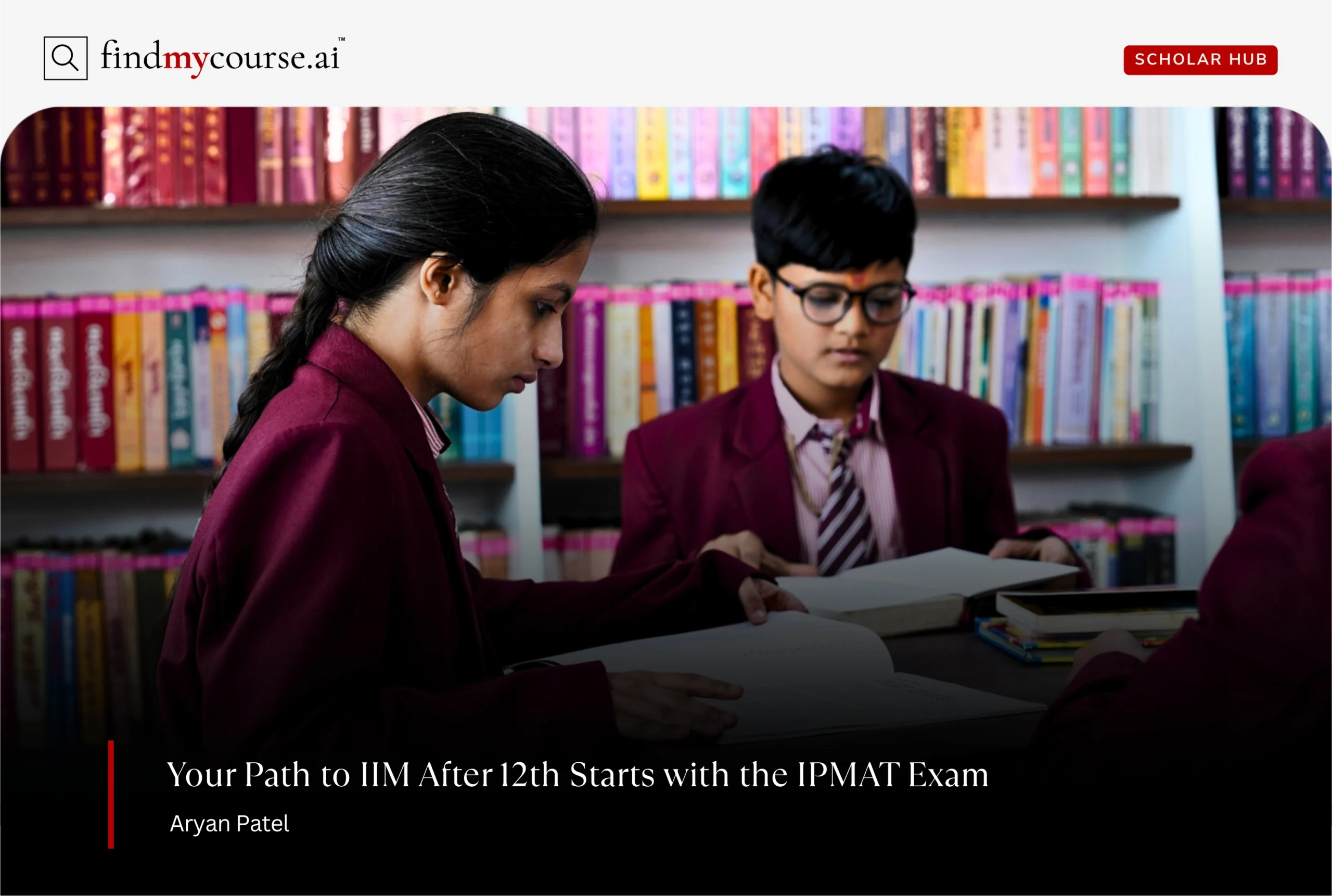
For decades, the Indian Institutes of Management (IIMs) were seen as destinations reserved for graduates. However, the landscape of higher education has evolved significantly. Today, the IPMAT Exam offers a direct route for students to enter IIMs immediately after Class 12, reshaping traditional academic pathways and long-term career planning.
This shift reflects a broader change in how college education is being structured, with integrated programs gaining popularity among students who want clarity early in their careers.
Instead of waiting for years, students now have the option to begin their management journey at 17 or 18. For many, this is not just an opportunity—it is a strategic head start.
What is the IPMAT Exam
The IPMAT (Integrated Program in Management Aptitude Test) is a national-level entrance test conducted primarily by IIM Indore and IIM Rohtak. It serves as the gateway to the five-year Integrated Programme in Management (IPM).
This program combines undergraduate and postgraduate education into a single structured course. Students spend the first three years building a foundation in business, economics, and social sciences, followed by two years of advanced MBA-level learning.
What makes this model important is its continuity. Students do not need to prepare for another entrance exam like CAT midway through their journey. Instead, they progress seamlessly into the MBA phase.
In recent years, more institutions have adopted similar models. As a result, the relevance of this exam has grown beyond just two IIMs, making it a key decision point for students exploring early academic pathways.
Benefits of Taking the IPMAT Route After School
Choosing the IPM pathway right after Class 12 offers early clarity and a structured approach to building a career in management. It allows students to grow academically while gradually understanding industry expectations.
- Early Entry into IIMs
Students get the opportunity to study at prestigious institutions right after school. This early exposure not only builds confidence but also helps them adapt to a highly competitive and enriching academic environment from the start. - Integrated BBA + MBA Journey
The program combines undergraduate and postgraduate studies into one seamless path. Students do not have to prepare separately for exams like CAT later, which reduces pressure and allows them to focus more on learning. - Skill-Focused Development
Throughout the program, students engage in case studies, group discussions, presentations, and internships. These experiences help in developing communication, analytical thinking, and problem-solving skills over time. - Better Career Clarity
Since students begin management education early, they gain exposure to different domains such as finance, marketing, and consulting. This helps them make more informed career choices as they progress. - Strong Long-Term Advantage
Graduating from an IIM with both foundational and advanced knowledge provides a strong edge in the job market. Over time, this early start can contribute to better roles and career growth opportunities.
IPMAT Exam Eligibility and Ideal Candidates
The IPMAT Exam is open to students who have completed Class 12 or its equivalent from a recognized board. Most institutes require a minimum of around 60% marks for general category candidates, with relaxations for reserved categories.
There are also age-related criteria, which ensure that applicants fall within a specific range after completing school.
While students from all streams can apply, certain traits make a candidate more suited for this pathway. A strong grasp of basic mathematics and English is helpful, though not mandatory at an advanced level.
More importantly, students should have curiosity, analytical thinking, and a willingness to learn across disciplines. The program is designed to be rigorous, so consistency matters more than short-term performance.
Students who enjoy problem-solving and structured learning environments tend to adapt well to this format.
IPMAT Exam Pattern and Structure
Unlike many school-level tests, this exam focuses on aptitude, logical thinking, and time management rather than rote memorization. As a result, students need both conceptual clarity and the ability to apply concepts quickly under pressure.
The exam is usually divided into two main sections—Quantitative Ability and Verbal Ability. In some cases, especially in exams conducted by certain institutes, a Logical Reasoning section is also included to further assess analytical skills.
Exam Pattern Overview
| Section | Focus Area | Nature of Questions |
| Quantitative Ability | Mathematics & problem-solving | MCQs + Short Answer |
| Verbal Ability | Reading & language skills | MCQs |
| Logical Reasoning | Analytical thinking | MCQs (select exams) |
The total duration is typically around two hours. Negative marking is applicable in most sections, so accuracy becomes just as important as speed.
Key Points to Remember
- The quantitative section often feels challenging due to the variety of topics and limited time.
- The verbal section tests reading comprehension, grammar, and vocabulary in a practical context.
- Time management plays a crucial role, especially when switching between sections.
- Regular practice is necessary to improve both speed and accuracy over time.
IPMAT Exam Syllabus and What to Study
The Exam draws its content from school-level fundamentals, but the application level is higher. Students need to move beyond basic understanding and focus on problem-solving speed.
The IPMAT syllabus is divided into two major areas: quantitative ability and verbal ability.
Quantitative Ability
- Arithmetic (percentages, ratios, time & work)
- Algebra and equations
- Geometry and mensuration
- Probability and statistics
Verbal Ability
- Reading comprehension
- Grammar and sentence correction
- Vocabulary usage
The IPMAT exam syllabus may look familiar at first glance. However, the difficulty lies in applying these concepts under time constraints.
Consistent practice is key. Students should regularly attempt mock tests and analyze their performance. Over time, this builds both speed and confidence.
Top IPMAT Colleges and Program Options
The number of institutions offering IPM programs has increased steadily. This gives students more options when considering IPMAT colleges.
Here are some of the leading institutes:
| Institute | Program Type | Admission Process |
| IIM Indore | IPM | Test + Interview |
| IIM Rohtak | IPM | Test + PI |
| IIM Ranchi | IPM | Test + Interview |
| IIM Jammu | IPM | JIPMAT |
| IIM Bodh Gaya | IPM | JIPMAT |
Each institute has slight variations in its selection process. Students should review these details carefully before applying.
As more IPMAT colleges emerge, competition remains high, but opportunities are also expanding.
Selection Process Beyond the IPMAT Exam
Clearing the IPMAT Exam is only one part of the admission process. Shortlisted candidates are usually invited for a Personal Interview.
This stage evaluates communication skills, clarity of thought, and overall personality. Academic performance in school may also play a role in final selection.
Students should prepare by practicing basic interview questions, staying aware of current events, and developing confidence in expressing their ideas.
A balanced preparation approach works best here. Academic strength alone is not enough; presentation and awareness matter equally.
Conclusion
The IPMAT Exam represents a significant shift in how students approach higher education in India. It offers a structured and early entry into one of the most respected academic ecosystems in the country. At the same time, it requires clarity and commitment. Students must be ready to invest five years in a rigorous program.
For those who are certain about a career in management, this pathway can be both efficient and rewarding. The decision ultimately depends on individual goals, learning style, and long-term vision.